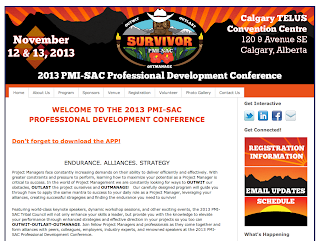
That's not to say that going to the PMI Southern Alberta Chapter's PDC (professional development conference) in Calgary on Tues 12 and Weds 13th is not a smart move, it is.
If you can get to the TELUS convention centre in Calgary there's a bumper agenda of speakers with all sorts of perspectives on how to use your survivor themed skills to out wit, out last and out manage project issues!
If you can't get there watch this space as I'll be adding a link to my presentation on using project coach-mentoring to boost post PMP professional development once PMI-SAC has been the first to see it.
If not you could try and sign up with the recorded sessions IiL (only available until Dec 5th) delivered for International Project Management Day 2013 that happened last week. There are some great speakers on here talking on all sort of topics from trends in PM, mentorship, ISO standards and everything between. Dr Kerzner is one of the key notes talking on lessons learned providing opportunities with (international project management day founder) Frank Saladis.
If that fails you can always call on me and we can discuss how you know what development you need and where you can find it.
Sunday, November 10, 2013

Saturday, June 1, 2013
Taming the Monkey Mind - Cultivating Focus and Co-operation!
Science is proving to us that it is possible to cultivate focus - and it's by using meditation techniques.
The benefits are more that I had thought too.
An article in Harvard Business Review Blog by Peter Bregman states:
"Research shows that an ability to resist urges will improve your relationships, increase your dependability, and raise your performance. If you can resist your urges, you can make better, more thoughtful decisions. You can be more intentional about what you say and how you say it. You can think about the outcome of your actions before following through on them."And following through on actions is one great way to build trust and co-operation with those you interact with. It is something that team players value in a leader or manager.
Focus is a dimension of personality that impacts life every day. On one end of the spectrum it can inhibit being successful or on the other get in the way of being sociable and flexible to opportunities in life as they arise.
In his research Richard Davidson uses the term attention and he considers what happens to it from two perspectives:
- in the presence of life's emotional experiences (open non-judgmental awareness)
- in the presence of normal sensory input (selective attention).
Focus or selective attention can be managed - one choses the right setting for them to work in for instance, selects the right amount of ambient noise, interruptions etc.
Open non-judgmental awareness is the ability to be receptive to what comes into your thoughts without getting sucked into it. Some buddhists call this shenpa - that hook of judgmental attachment. Open non-judgmental attention can be cultivated by meditation.
How do you cultivate focus? Can you manage your emotions in the same way as sensory input? What about for your team?
Interesting thought! If you want to do an experiment on your own focus/attention to test this information out I'd love you to share.
Thursday, May 16, 2013
Your team does not have to like you but they do need to trust and respect you...
I really like the way Ken Blanchard of the one minute manager makes things simple and this post of his on fastcompany is no different.
Ken and Scott talk in their article about the impact of trust on being able to implement change - something project managers are all so familiar with. It's a push for a new co-authored book (of course) Trust Works! Four Keys to Building Lasting Relationships, but useful none the less.
We've long known for healthy working relationships it is important to foster respect, trust and reliability and these are underpinned by ability to communicate directly, actively listen and to honour commitments. This fits in nicely with the 4 attributes the main author, Cynthia Olmstead, states:
Ken and Scott talk in their article about the impact of trust on being able to implement change - something project managers are all so familiar with. It's a push for a new co-authored book (of course) Trust Works! Four Keys to Building Lasting Relationships, but useful none the less.
We've long known for healthy working relationships it is important to foster respect, trust and reliability and these are underpinned by ability to communicate directly, actively listen and to honour commitments. This fits in nicely with the 4 attributes the main author, Cynthia Olmstead, states:
- Able--Demonstrate Competence
- Believable--Act with Integrity
- Connected--Care about Others
- Dependable--Maintain Reliability
As a coach I now challenge you to take this A-B-C-D and rate yourself today - how are you doing?
Thursday, April 25, 2013
Calling Project Managers of geeks, nerds and techies
If "can't live with them but can't live without them" or "they speak another language" or "I just don't understand them" is something you face every day with some of your project team then you might want to spend a few mins reading this blog post about how to manage geeks nerds and techies ...
The article is more specifically
I like to because it underlines why we need to give these often brilliant but misunderstood or totally incomprehensible "inscrutable and eccentric bunch" what they need.
The fact is that if you find the right people as in the Jim Collins Good to Great approach “The right people (even techies), are self motivated and will not need to be fired up, and because of their inner drive will produce enduring great results,”
What this means if you don't have to closely manage these people - you have to hear them, really listen to what they are saying (even if you don't understand it all - ask intelligent questions to get the information into terms you can understand - you never know how much you'll learn by listening and developing your pseudo-tech talk. Give them the time of day and your respect for what they do.
Above all give them space to do what they need to do. It might look like nothing to you — thinking usually isn't accompanied by steam pouring out of their ears ;-)
Yes, there will be slackers but they are not the right people, and you'll see that in their (lack of) productivity, their (not) belonging, and their inability to baffle you with technical enthusiasm for what they are working on. You'll know.
"Consider this assertion: Technology professionals are one of the most valuable populations of human talent in any organization – public, private, for profit, not for profit. If you agree with that, then we as leaders must make a study of how best to motivate, influence and inspire our technologists. The burden is on us. Many believe that technology professionals are extraordinarily valuable as I do, and yet very different from other people and therefore require us to meet them where they live as a matter of necessity."
Sometimes diamonds take a lot of polishing.
The article is more specifically
Geeks, Nerds & Techies and Inspiring Next-Gen Mobile Solutions
Enabling next-gen mobile apps means meeting technologists on their own turf.
http://www.enterprisemobilehub.com/blogs/marc-b/geeks-nerds-techies-and-inspiring-next-gI like to because it underlines why we need to give these often brilliant but misunderstood or totally incomprehensible "inscrutable and eccentric bunch" what they need.
The fact is that if you find the right people as in the Jim Collins Good to Great approach “The right people (even techies), are self motivated and will not need to be fired up, and because of their inner drive will produce enduring great results,”
What this means if you don't have to closely manage these people - you have to hear them, really listen to what they are saying (even if you don't understand it all - ask intelligent questions to get the information into terms you can understand - you never know how much you'll learn by listening and developing your pseudo-tech talk. Give them the time of day and your respect for what they do.
Above all give them space to do what they need to do. It might look like nothing to you — thinking usually isn't accompanied by steam pouring out of their ears ;-)
Yes, there will be slackers but they are not the right people, and you'll see that in their (lack of) productivity, their (not) belonging, and their inability to baffle you with technical enthusiasm for what they are working on. You'll know.
"Consider this assertion: Technology professionals are one of the most valuable populations of human talent in any organization – public, private, for profit, not for profit. If you agree with that, then we as leaders must make a study of how best to motivate, influence and inspire our technologists. The burden is on us. Many believe that technology professionals are extraordinarily valuable as I do, and yet very different from other people and therefore require us to meet them where they live as a matter of necessity."
Sometimes diamonds take a lot of polishing.
Thursday, April 18, 2013
Ok so if you really are having trouble with the people, here are 5 excellent articles to help
Harvard Business Review has some of the best articles around when it comes to general management issues and this compendium of 5 is no slouch if you are in need of tips how to manage difficult people.
- Three Ways to Deal with a Passive-Aggressive Colleague - Give feedback. Focus on the work, not the person. Ask for commitment. "How to Deal With a Passive-Aggressive Peer" by Amy Jen Su and Muriel Maignan Wilkins.
- Keep Your Composure, or Walk Away - acknowledge and manage your feelings first "The No-Drama Rule of Management" by Peter Bregman.
- Three Tips for Resolving a Conflict with Your Coworker - Find common ground. Hear what they are saying. Propose a Solution. "The Right Way to Fight" by Amy Gallo.
- Turn Your Competitors into Allies - first understand where they are coming from."Managing Yourself: Stop Holding Yourself Back" by Anne Morriss, Robin J. Ely, and Frances X. Frei.
- Stop Being So Nice - Reflect. Get feedback. Experiment and evolve "Is Your Culture Too Nice?" by Ron Ashkenas
Tuesday, April 9, 2013
If you are going for your PMP certification this year read this...
There is a very helpful blog post from PMChampion about the changes to the PMBoK (version 5 has been released) and the exam change that follows this.
( http://www.pmchampion.com/blog/pmp-exam-prep/new-pmp-exam-dates-released/ )
If you are taking any of the exams in July or August (this year 2013) this blog helps you identify which PMBoK is being used for the exam (remember PMP is a knowledge based qualification so you need to be using the right body of knowledge).
The blog also lists the changes to the PMBoK between versions 4 and 5 - more on PMO, up from 42 to 47 processes. stakeholders are in, communication has been revised, time-cost, scope and cost also updated.
Happy studying folks.
( http://www.pmchampion.com/blog/pmp-exam-prep/new-pmp-exam-dates-released/ )
If you are taking any of the exams in July or August (this year 2013) this blog helps you identify which PMBoK is being used for the exam (remember PMP is a knowledge based qualification so you need to be using the right body of knowledge).
The blog also lists the changes to the PMBoK between versions 4 and 5 - more on PMO, up from 42 to 47 processes. stakeholders are in, communication has been revised, time-cost, scope and cost also updated.
Happy studying folks.
Thursday, March 21, 2013
PMs dull - never!
If you ever thought being a project manager was dull, you need to meet Nina
this is a lovely vimeo of a touchingly funny lady on stage... go on click the link, a laugh a day is wonderful tonic!
this is a lovely vimeo of a touchingly funny lady on stage... go on click the link, a laugh a day is wonderful tonic!
Thursday, February 7, 2013
Which certification should you use as a project manager?
If you are considering certificating as a Project Manager there are many credentials and certifications available - which one you choose should depend on which industry you are in and your geography - there's a full and interesting discussion about this on LinkedIn at the moment.
The short answer to "Which certification should you use as a project manager?" is probably dependent on who you are trying to impress/ persuade/satisfy with it. Start by asking why you want to get it, then consider the options.
The short answer to "Which certification should you use as a project manager?" is probably dependent on who you are trying to impress/ persuade/satisfy with it. Start by asking why you want to get it, then consider the options.
Thursday, January 17, 2013
Running a PMO and not sure how to evaluate it?
A member of the LinkedIn PMO Coach forum Ken Martin has comprised a list of 25 possible metrics for PMO performance evaluation http://kigospace.com/public/wp-content/uploads/2013/01/25-PMO-Metrics.pdf
Ken suggests you selective choose from them, I add you choose those which are meaningful to your organisations' business goals. Your PMO needs to fit with what your organization is trying to achieve.
There's some great research out there about PMOs much coming form the Canadian Research Chair at QUAM (University of Quebec in Montreal), Canada - you can read a summary of one of their research projects at https://aupri.athabascau.ca/PHDSummaryMAubry and this site Project Research Institute has another of their research projects under review too (https://aupri.athabascau.ca/node/343)
Research shows that PMOs aren't intended to last forever, they are brought into existence to fulfill a purpose: to support project operations or to control project operations. If an organization doesn't have to have rigourous control (because lives or the safety of the planet depend on it) then a support PMO is usually much more effective but it must be meeting organization needs as well as making lives simpler.
Bottom line: by all means have a PMO but be clear why and how it contributes to your organization's business goals.
Ken suggests you selective choose from them, I add you choose those which are meaningful to your organisations' business goals. Your PMO needs to fit with what your organization is trying to achieve.
There's some great research out there about PMOs much coming form the Canadian Research Chair at QUAM (University of Quebec in Montreal), Canada - you can read a summary of one of their research projects at https://aupri.athabascau.ca/PHDSummaryMAubry and this site Project Research Institute has another of their research projects under review too (https://aupri.athabascau.ca/node/343)
Research shows that PMOs aren't intended to last forever, they are brought into existence to fulfill a purpose: to support project operations or to control project operations. If an organization doesn't have to have rigourous control (because lives or the safety of the planet depend on it) then a support PMO is usually much more effective but it must be meeting organization needs as well as making lives simpler.
Bottom line: by all means have a PMO but be clear why and how it contributes to your organization's business goals.
Wednesday, January 9, 2013
Flexible working - it's flexible and it's work - are you doing it successfully?
This very short news article hints at one of the most interesting ways to keep team members engaged in their work - flexible working. http://metronews.ca/news/calgary/499663/calgary-aims-to-make-2013-the-year-of-flexible-work/
There are many possible reasons why flexible working is so attractive to people and how it can beneficial to your organization.
Sometimes it's as simple as a change is as good as a rest, other times it's saving time so that you can make your child's/ partner's event, often it's one way to give people breathing space to either concentrate, catch up or simply get some quiet time (that's right not everyone is an extrovert - sometimes we just need quiet time to recharge our batteries). Think of days in flexible working as preventative mental health days!
Of course with flexibility and freedom or autonomous work comes personal responsibility. If you are leading a team and are nervous about flexile working first seek to establish how the person's environment out of the office will help them be productive, then be clear that the flexible worker understands what it is they are setting out to achieve in this alternative setting. Basically it's a mind set shift to work outside of the office but most professional people who have been through higher education understand that more work goes on outside the classroom under their own direction than in it and so have great potential for flexible working.
Above all the key to success in flexible working is in the name - the person is still required to work they have flexibility in location and perhaps task and the time frame that work is done over but it is still work. The best way for employee and employer to get success is to be clear about expectation - what the employee gets from the arrangement and what the employer gets too. Presentee-ism helps no-one.
There are many possible reasons why flexible working is so attractive to people and how it can beneficial to your organization.
Sometimes it's as simple as a change is as good as a rest, other times it's saving time so that you can make your child's/ partner's event, often it's one way to give people breathing space to either concentrate, catch up or simply get some quiet time (that's right not everyone is an extrovert - sometimes we just need quiet time to recharge our batteries). Think of days in flexible working as preventative mental health days!
Of course with flexibility and freedom or autonomous work comes personal responsibility. If you are leading a team and are nervous about flexile working first seek to establish how the person's environment out of the office will help them be productive, then be clear that the flexible worker understands what it is they are setting out to achieve in this alternative setting. Basically it's a mind set shift to work outside of the office but most professional people who have been through higher education understand that more work goes on outside the classroom under their own direction than in it and so have great potential for flexible working.
Above all the key to success in flexible working is in the name - the person is still required to work they have flexibility in location and perhaps task and the time frame that work is done over but it is still work. The best way for employee and employer to get success is to be clear about expectation - what the employee gets from the arrangement and what the employer gets too. Presentee-ism helps no-one.
Monday, October 15, 2012
Prioritizing work with urgent and important - it would be funny if it weren't so true!
One of the very best tools for managing task overload is to get a grip on prioritizing work into what matters (important) and what's critical (urgent). This prioritization method is from Stephen Covey's classic The 7 Habits of Highly Effective People - it's an oldie but really practically useful.
A simple grid is the best way to visualise this. You can use a white board too.

This is a wonderfully funny youtube clip of the marvellous Harold Taylor demonstrating why the urgent and important style of prioritization and work organization is extremely valuable - stay tuned to the end and you'll see why this is important for not just you but those in your organization too.
Enjoy!
A simple grid is the best way to visualise this. You can use a white board too.

This is a wonderfully funny youtube clip of the marvellous Harold Taylor demonstrating why the urgent and important style of prioritization and work organization is extremely valuable - stay tuned to the end and you'll see why this is important for not just you but those in your organization too.
Enjoy!
Thursday, October 11, 2012
How do I find a great coach or mentor?
As a coaching professional I seem to meet a new coach every day - either in the flesh or online. They either tell me they can coach anyone to transform their life or they talk about who they connect with most. It’s the second group I warm to most, because life experience matters in coaching.
The most excellent skill set that we learn when certifying as a coach is massively valuable, it does help us support people in transforming their lives in small and large ways but, to me, a coach will really help you move onward and upward if they also understand the specific work or life challenges that you are living right now.
Seek out coaches who have had
formal coach training
AND
life experiences that matches your situation.
The most effective lasting change happens when it becomes part of everyday life. When integrated into what and how you do things on an every day basis, change really sticks. Change sticks when it fits in, when it helps you make life easier. Someone who understands your every day can more easily help this happen.
A great coach will help you discover how this can work for you and because every one is different there is no one right way to do this. Ask your coach how they coach people, then ask how they can meet your individual needs, challenges and help you find your best opportunities for development.
The best way to find a coach is by referral (from HR, from professional association, from colleagues), but what suits your colleague may not always suit you because, you are, well, you. Using an online search can also help. Not all qualified coaches are listed on the professional coaching association’s lists but those on the list are most likely qualified. Mentors used by your professional association may be open to taking on coaching clients.
The very best thing you can do is try a coach out: email and ask for their coaching resume to check if their training and life expertise matches your needs; if it does, ask for a free laser coaching session - after 15-20 mins on the phone you will have a sense of whether this person gets you and your situation.
Final thought: if you can’t find a match ask a coach to help you find the right coach for you.
Checklist
Check point: Formal coach training?
Check point: Has this coach resolved a similar or related issue to yours or worked or lived in a related environment to you?
Check point: Does this coach have a game plan that is flexible to your needs and perspectives?
Tuesday, October 9, 2012
the value in being mentored
In Calgary we have an excellent PMI chapter who have the vision to run a really great mentoring program for some lucky PMs. How do I know this? I'm one of their mentors.
If you are not lucky enough to be in the PMI_SAC program what can you do? There is real value in having a mentor and they are around you everyday if you look.
Who could your mentor be?
We often have a contact with people in our lives that walk their talk in certain areas or have skills that we would like to emulate ourselves.Life is full of mentors, and realising this helps us build our own expertise and the resources that help us succeed. Mentors can come from all walks of life and, like friends there is no one mentor that fits all; no-one will match you exactly because well, because you are you.
People who intimidate us because they are great at what they do or who give good strong (and sometimes hard to hear) feedback will make the best mentors. If someone around you inspires you to step up and do better they might be the very person you are looking for.
Informal mentors
Many of us have mentors in our life just because they are around us when we need them - proximity mentors if you will.This mentor is unlikely to know that they are your mentor, you simply benefit from being exposed to their experience. For some potential mentors the mentoring arrangement has to not only informal but strictly watch and learn. Other times you might be able to ask curious questions which get a potential mentor to reveal more about how or why they do something in a particular way.
Formal mentors
Managing to be in a formalized mentoring relationship opens up your mentors experience to you more fully. You can easily ask them questions, they by being a mentor will make time available for just that.Additionally, trained or experienced mentors will start to ask you questions to draw out what your challenges are, what you already know and help you build on your natural talents.
Asking curious questions
Whether you are in a formal or informal mentoring relationship developing curiosity is the first step in learning. Formulating curious questions is a way to explore something without the expectation of knowing the answer. They are open ended questions, often not fully (or grammatically - eek! don’t tell my grammar mentor!) formulated. They are designed to get the other person talking.How did you chose that approach?
I’m intrigued how your worked out that ...
Would you mind telling me more about the way you ...
You always seem to successful in this situation, how do you get it to work out so often?
If you can’t ask your mentor a question directly or can only ask questions infrequently then your curious question helps you focus on what you want to observe in the mentor’s behaviour.
The best way to learn from a mentor is to be curious and act on it. So, who’s your mentor?
If you would like to be experience the coaching aspect of mentoring the Calgary Project Managers Mastermind Group is a great place to meet one
or you can call me
Subscribe to:
Posts (Atom)